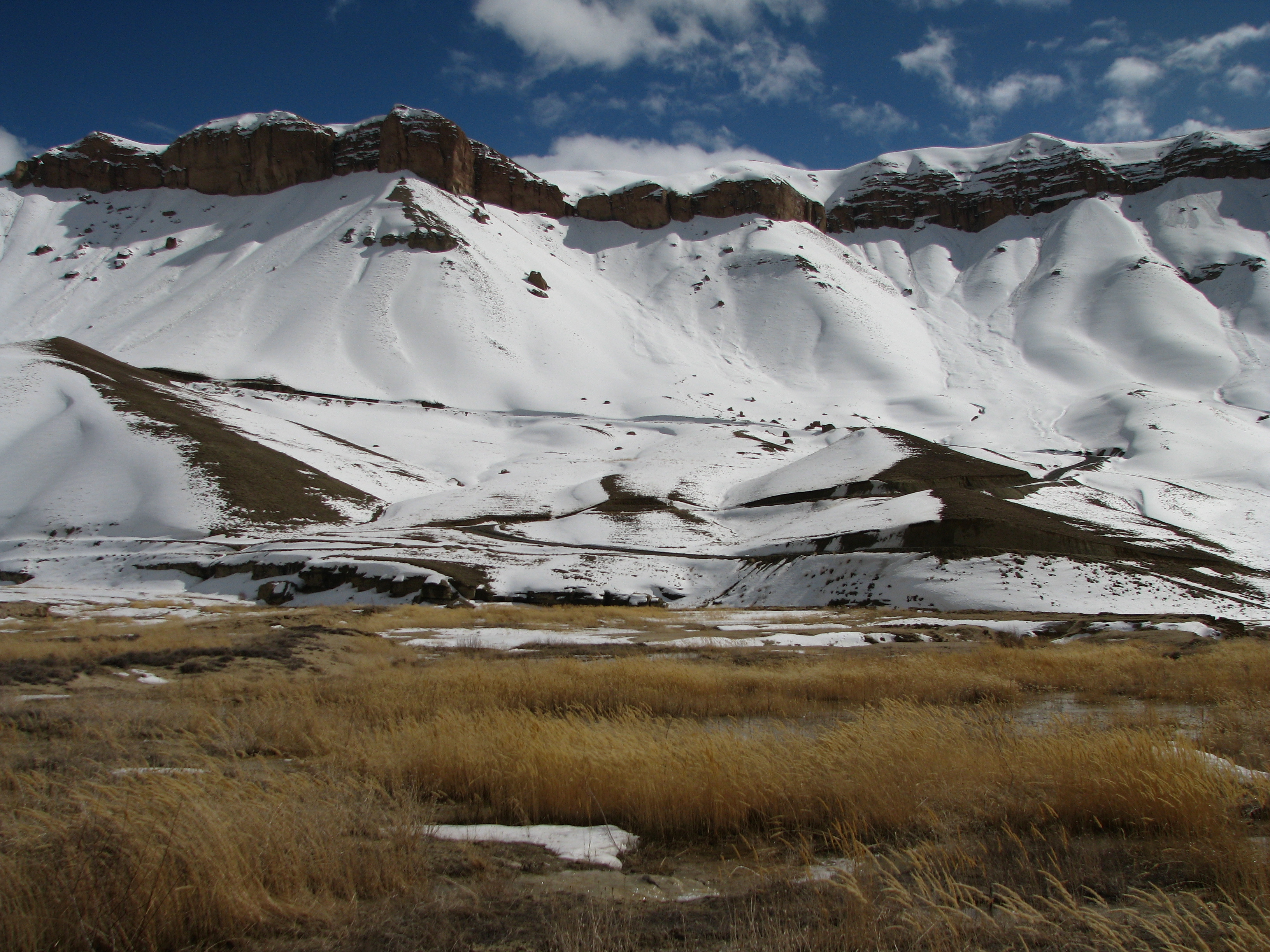
It’s a headscarf day. I throw mine over my head, fold it at the chin and wrap the free end around my neck and shoulders in the hopes that it’ll stay on without too much adjustment. We grab our things and head out to meet our ride. Today we’re going to Band-e-Amir! It’s Afghanistan’s first (of two) National Parks, established in 2009 with the help of the Bronx Zoo’s international conservation arm – Wildlife Conservation Society. It is not clear to us that the roads are in very good condition yet, it being spring and there still being a thin, and melting, blanket of snow up in the mountains, so we’ve decided to take what I like to call an “adventure van” – the min-van shaped, 4WD, high-clearance, 8-seater, manual shift vehicles that are common everywhere but the US and are perfectly suited for all kinds of off-road and on-road adventures. I’ve filed these away in the “why on Earth don’t we have these vehicles in the US” category, which is getting rather full at this point.
We pile in. Two other American staff, myself, the electrician, who happens to be from Band-e-Amir, another staff member who speaks very good English and is often up for adventures, and the driver. The women must sit not touching men, so we are in our own row, and the men are in the back and the front. The gals end up with the most room and the best view, however, so that works out just fine. The drive to Band-e-Amir is uneventful and beautiful. We pass by the gaping holes where the giant Buddahs were and see the honeycomb of caves in the surrounding cliff walls. All along the way there are the square mud walls of dwellings, donkeys resting by the road or carrying large loads, children playing, the occasional herd of shaggy sheep, and men and women going about their days. The willows by the creeks and irrigation ditches are budding, and there’s the barest wash of green where the cotyledons of winter wheat are just coming out from their long, cold, dormancy. The road follows the river valley, and our friend points out interesting natural features and tells us some local legends.
After the turnoff to Band-e-Amir, we drive about 20 meters before the driver stops, gets out, and locks the front hubs to put the van in 4WD. We proceed up the muddy ruts in the road faster than I’d like so we can make it up the hills and not get stuck. There are a few harrowing moments of fishtailing, and another one where we slid almost entirely perpendicular to the road on a downslope which lasted long enough that I had time to calculate the angle of the slope we were on, the speed we were going, and our potential resting place if we continued to skid and ended up rolling down the hill. I was busy fighting the instinct to rip off my seatbelt so I would be free (to do what, I don’t know, but it was a powerful feeling) when the driver regained control of our vehicle and we continued down the hill pointed in a more typical orientation. Conversation was a bit sparse after that, but we managed to get to our destination with no more adrenaline-producing incidents, and the snow-covered hills outside my window made it all entirely worth while. The northward facing slopes and the high parts of the Central Highlands are still pretty well blanketed in snow, though the days are warm enough now that the snow is coarse and slushy.
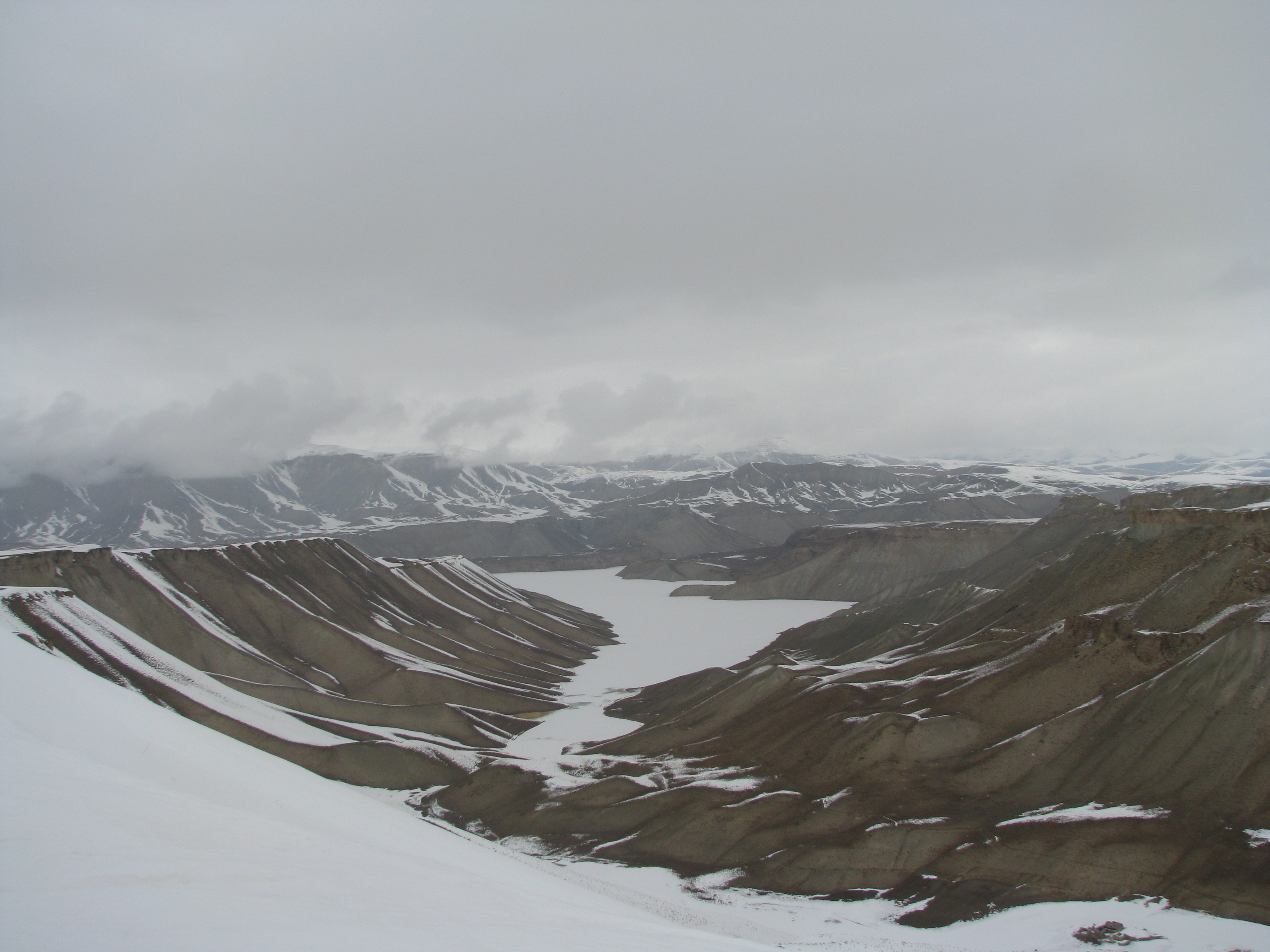
Lake Zulfiqar
Soon after passing another adventure-van full of what looked to be wealthier city-folks who had evidently decided to give up on their journey and were cooking and eating lunch in the middle of the 1.5 lane snow-and-mud covered track, we stopped to get our first glimpse of a lake. Expecting the turquoise blue of a clear, deep, lake, we were all surprised when we saw a frozen whiteish expanse hemmed in by high, steep, brown cliffs. It was still frozen! This was Lake Zulfiqar, the northernmost of the seven (six officially) lakes that comprise Band-e-Amir. Zulfiqar means “sword” in Dari, so as you might have guessed, it is a long and narrow lake. A little while later, we reached the village of Band-e-Amir and set out to explore.
Band-e-Amir is an interesting place. “Band” means “lake,” and “Amir” means “king,” so the entire complex is the Lakes of the King. The most impressive part is an unusual geological feature that is essentially a natural dam reaching at least 10 or 15m high, and encircling the end of Lake Haibat, keeping it from flooding the valley. It truly is amazing, though it is not the reason there was a National Park established here. The park was established to protect the biodiversity up the canyon from the lakes, where people don’t so much live. Below and near the main Band-e-Amir area there are 14 small villages, and the river downstream is more or less continuously populated. WCS cites wolves, wild sheep, foxes, fish, ibexes, many species of birds, and of course some interesting plants as resident in the area.
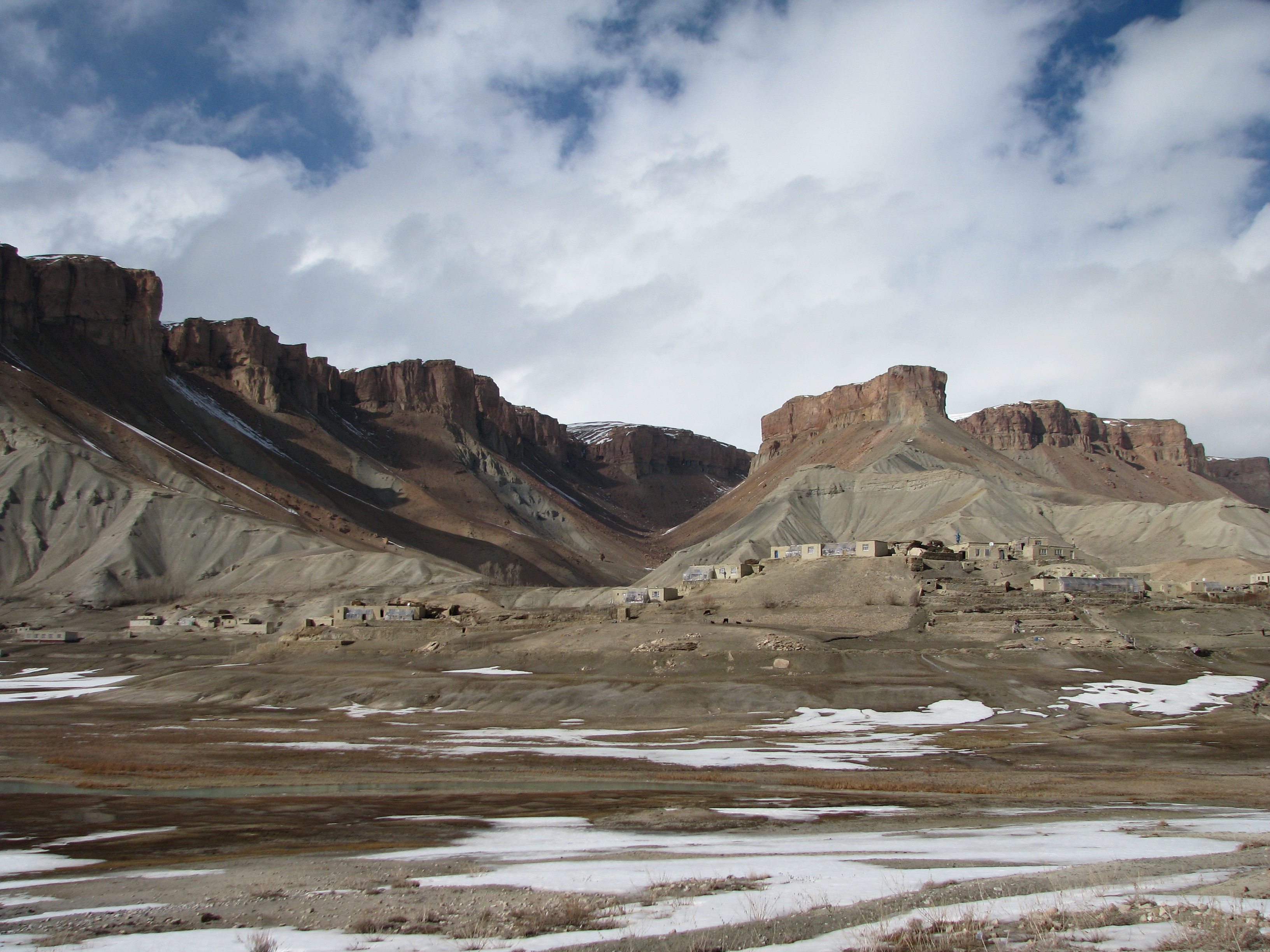
Village at Band-e-Amir
Like much of this area of Afghanistan, the villages are surrounded by high hills and distant mountains, making them unbelievably picturesque. The hills at Band-e-Amir are different from others I’ve seen in that they all seem to end not in peaks, but in plateaus, making them look like tables with long, flowing skirts. The slopes are treacherous looking piles of scree until the harder rock of the tops appears suddenly vertical, continuing up until the plateau is reached. Perhaps this area will look similar to the table lands of the desert southwest in the US after another few thousand years of erosion levies its land taxes. I asked our friend if he had ever been up on top of the mountains and he said, yes, he had, and what I gathered via translation was that he had walked up there with a few other guys and some sheep, and they had taken a hole in the rock that ancient people had made to get to the top – a tunnel of sorts, it sounded like. I asked how long the tunnel was, imagining something similar in magnitude to the Mines of Moria in Tolkein’s world. The answer was “20 minutes.” At a quick pace, 20 minutes would be a mile, and assuming the pace through an ancient rock tunnel is not exactly brisk, it’s still probably at least half a mile, which is impressive! The tunnel adventure sounded fun, though I never heard why the sheep were along for the trip.
Back to Band-e-Amir. As we left the adventure-van to explore the lake a light sleet started, the first of four different types of precipitation we experienced that day. This was Lake Haibat, the main lake, which collects waters drained from Zulfiqar.
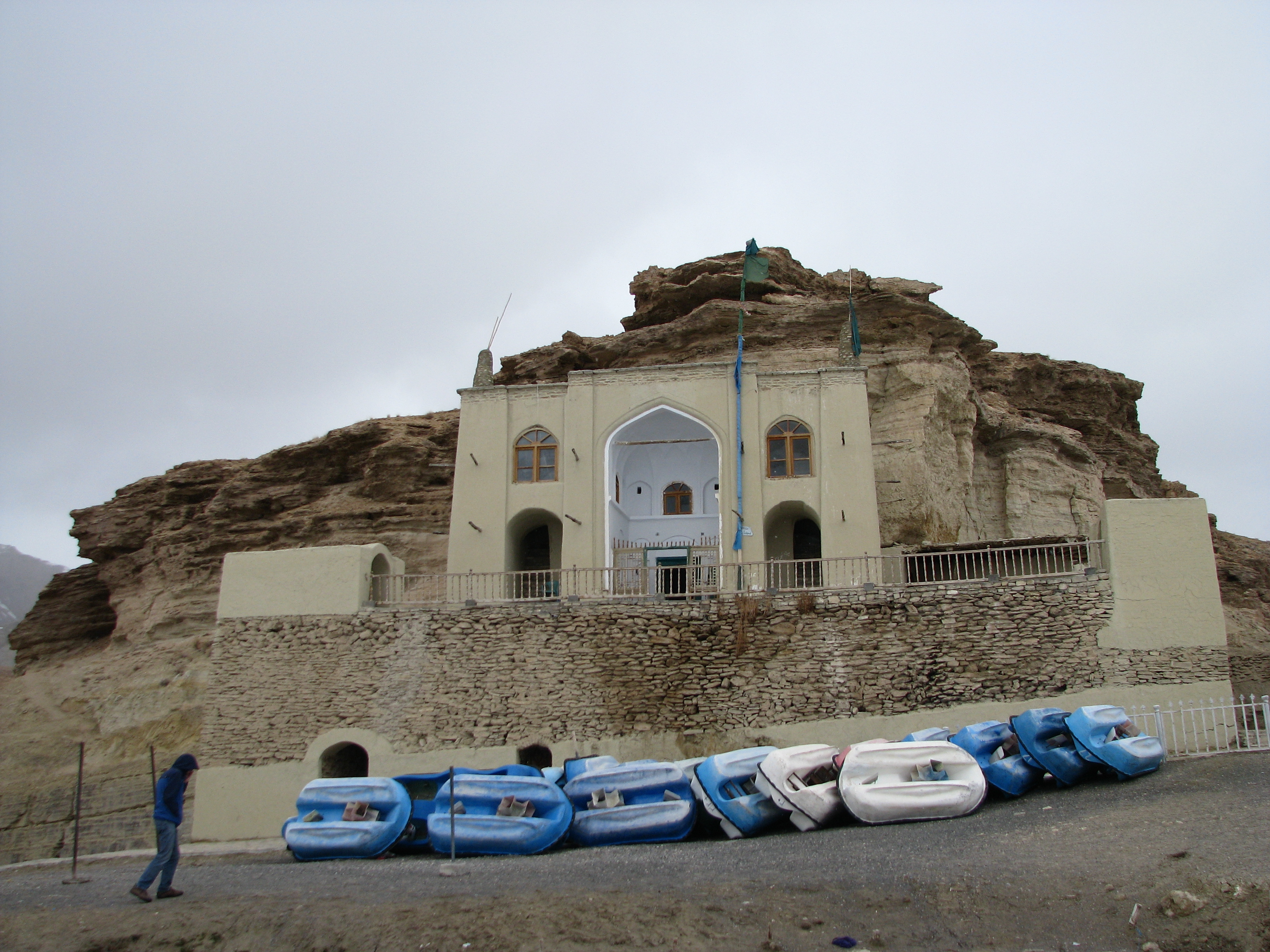 Haibat’s waters purportedly have healing powers, the reason for which I will get to later. Unfortunately for us, we would have to bear the burdens of our health problems for a while longer because this lake was also frozen. The pedal-powered swan boats were lined up on the shore and there w
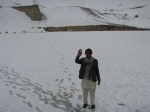 as only one other brave soul about who was washing a teapot in the lake. The unexpected benefit of our climatic situation was that the ice was thick enough to walk on. This we determined after much hesitation and some very enthusiastic jumping on the ice by the Afghans in our party. The sleet changed to a light snow and we had a marvelous time walking around on the ice in the middle of a giant lake. It was magical.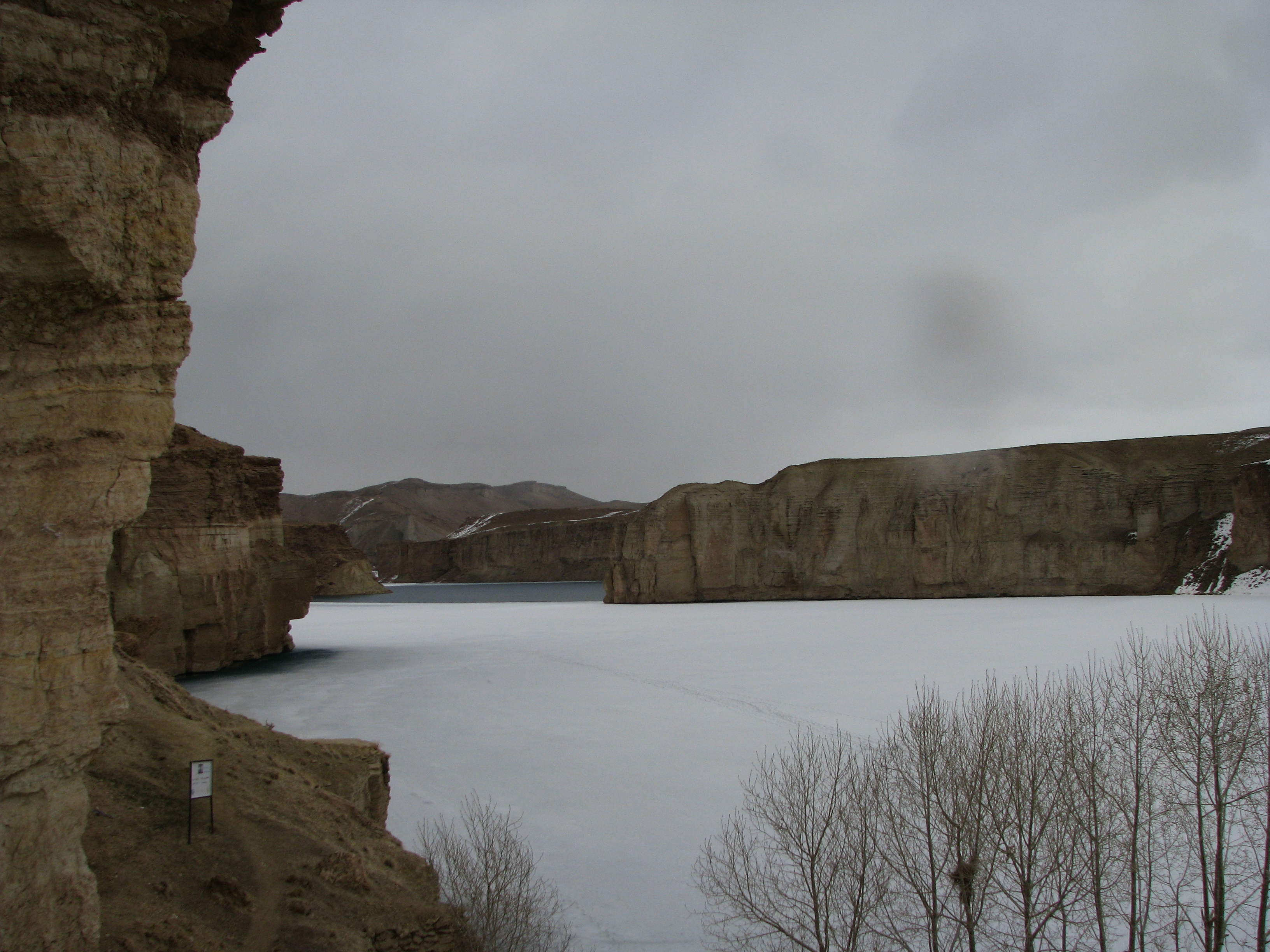
Since we were in the company of a local (we had already run into his uncle on the way), we headed to a local house for lunch. On the way, the driver pulled us into a morass of mud he couldn’t get out of, and the adventure-van was well and truly stuck. Luckily, lunch was only about a 5 minute walk, so we abandoned the van and went to eat. Our friend’s cousin lived in a small, two-room house with glass windows and a spacious porch area covered in greenhouse plastic – a common practice for the winter. We sat down and were immediately offered tea, and then soon after a basin and water poured over our hands to wash. The room was cozy and warm and the cushions were comfortable. After some idle chat a blanket was spread on the floor in front of us and we were served huge flat pieces of naan, sour yogurt, broth with onions, chicken that had been cooked in the broth, slightly fermented sheep’s milk, and gargantuan piles of little fried fish from the lake. Everything was delicious, with the exception of the sheep’s milk. I have little idea of what the fish might’ve been, and I believe I’ve heard rumor that it’s not allowed to fish in the lake, but far be it for me to refuse a meal when I’m a guest. That discussion can be had outside of someone’s living room.
We spent the rest of the day hearing stories, gazing at gorgeous mountains, enjoying the suddenly sunny weather, and then returning to Bamiyan via a pleasant and much less harrowing trip out of the valley.
Long ago, there was a king called King Barbar who ruled the valley of Band-e-Amir. In a nutshell, he was a jerk. He liked to kill people, he kept slaves, and had a general disregard for the well being of his subjects. Lake Haibat rose and fell with the melting of the snow, and without a good dam, the waters flooded the valley every year and took out farms and houses. So every year, King Barbar had his slaves work on building a wall around the waters of Lake Haibat, but they could never build it fast enough or strong enough to hold the spring melt. But every year King Barbar would make the people keep working until the waters rose above the partially built wall, and every year all the workers drowned, the wall was washed away, and the valley flooded. It was clear even to King Barbar that this situation was untenable. Oh, and there also happened to be a dragon that was plaguing the village and came by to snatch up and eat various denizens of the town at will. King Barbar needed a solution.
So one day, King Barbar called Ali, also called Amir (also called many many other things), who was the prophet Mohammed’s son-in-law. This man could work miracles. King Barbar said he wanted three things: 1) to dam the water, 2) to get rid of the dragon that was also plaguing the village and eating people every year, and 3) Ali in chains. I imagine the King wanted the third wish, which may seem a strange favor to ask of the man who’s working miracles for your town, because he was threatened by Ali’s power. Ali decided that he would deliver all of those things, even himself in chains, if King Barbar became a Muslim. The King said yes, and Ali got to work.
First, Ali dammed the waters and created the rock wall at the head of Lake Haibat. Interestingly, this rock-wall really does look exactly like a dam, with an even top and small spillovers letting excess water flow out at a slow and controlled rate. While Ali was working, the villagers, who thought this must be a very hard job, brought him cheese. One of the lakes is now named Paneer after Ali’s cheese.
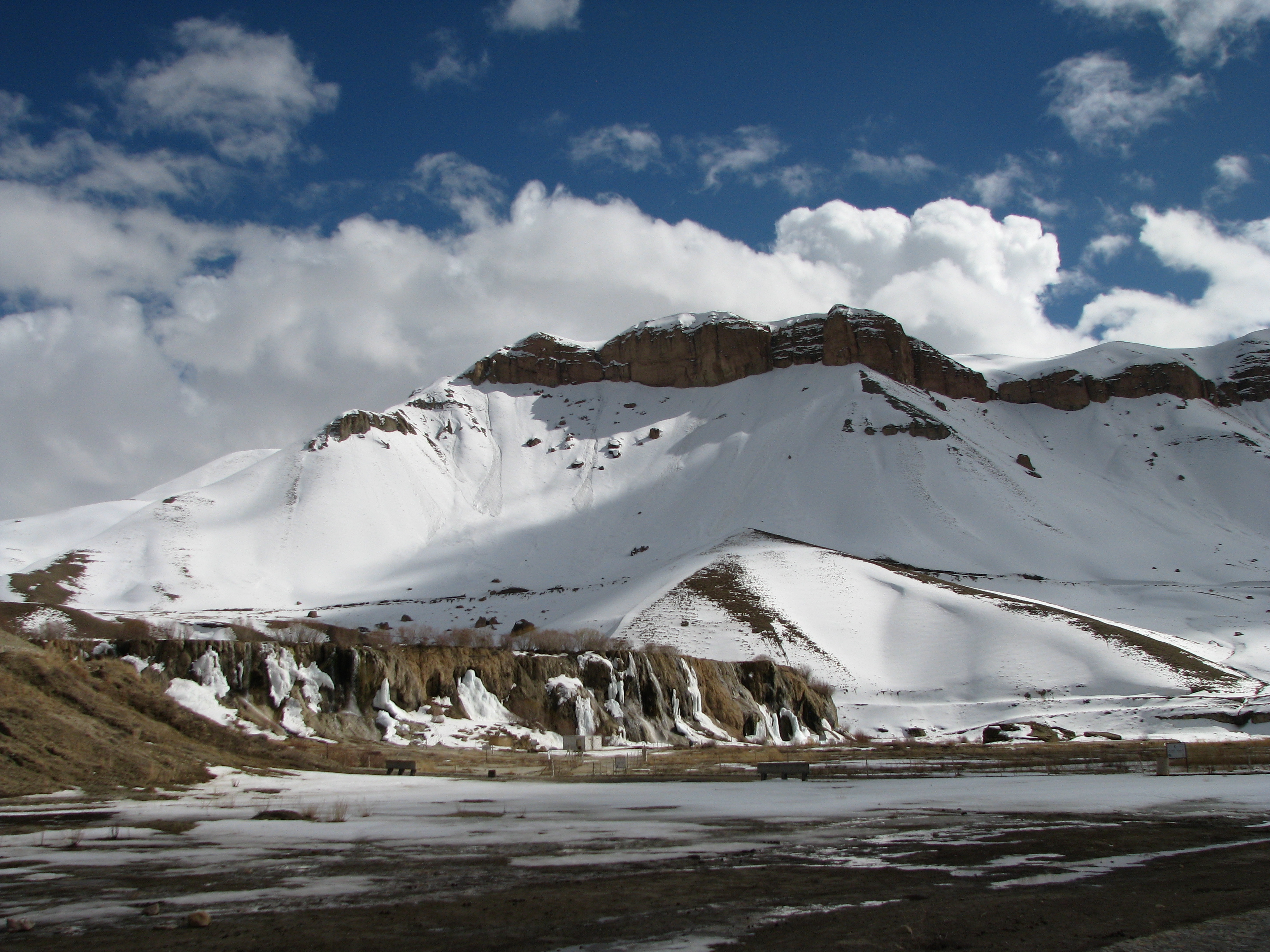
The dam below Lake Haibat
After he finishes the dam, Ali turns to the dragon problem. Next time the dragon comes by for a people-snack, Ali smotes it (the manner was unclear, but I imagine it was a very exciting event) and turns it to stone, where it now remains as a dragon-shaped ridge in a village outside Bamiyan, dribbling un-drinkable water from its nose. After dealing with the dragon, Ali returns to the village for the third thing: himself in chains and the conversion of King Barbar. However, King Barbar, who has been talking with the villagers, realized that they needed a little bit of water from the lake, and asked Ali to make a few waterfalls. Ali, of course, complies. Next thing you know, he delivers himself in chains, and asks King Barbar to convert.
Here is where the telling got fuzzy. Somehow, King Barbar, cruel ruler that he is, manages to peace out and everyone in the village is safe, freed from slavery, and the recipients of a steady and manageable trickle of water from the formerly flood-prone Lake Haibat. The villagers end up naming Lake Zulfiqar after Ali’s sword that he must have used to smote the dragon (I believe dragons are generally smoted with swords), and another lake is named Gholoman after the slaves, and Lake Qambar after Ali’s slave (according to Wikipedia, though in the context of the story I was told I don’t know why Ali had a slave).
And that’s it!
 orientnorth
Remarkable! The stories might be the best part (remember the ducks that land on the lake, which freezes, and when they take off they’ve made the Grand Canyon?). Any idea how the sheer tops of those hills were created? Looks like they were sheared straight off. MD
LikeLike